
The Full Interview with Ashton Phillips
Mealworms, moths, and frogs through the lens of trans theory — and so much more!
This is the full interview with Ashton Phillips, which was excerpted in the July 21, 2026 issue of Weekly Special.
Your recent show at the downtown LA gallery Persons Unknown brings together so many different threads in your practice. What was the starting point for the show, and how are all the elements related?
Since the first laws attempting to criminalize drag and gender-affirming care started cropping up around the United States in 2022 or so, I’ve been thinking about monsoons and superblooms as instances of collective power that can come out of nowhere and bring about enormous change and rebirth after long periods of intense adversity. This April, I made a pilgrimage to Death Valley to experience my first “superbloom.” It was otherworldly and not what I expected. I met, spent time with, and filmed thousands of thin, bright flowers, shimmering in the wind, floating almost like ghosts or mirages over an endless dry brown ground. They felt magical but also deeply fragile, like a breath or a song or a tear, that was not meant to last for more than a moment.
Within these flowers, though, I was surprised to find at least as many caterpillars happily nibbling, dozing, cozying up, rolling, slipping, and crawling around. I had no expectation of meeting these metamorphosing creatures when I arrived and no data or wifi signal to look up what they might be, so I encountered them without any preconceived notions of who they were, where they came from, or what they might become. This unknowing made room for lasting curiosity, wonder, and delight.
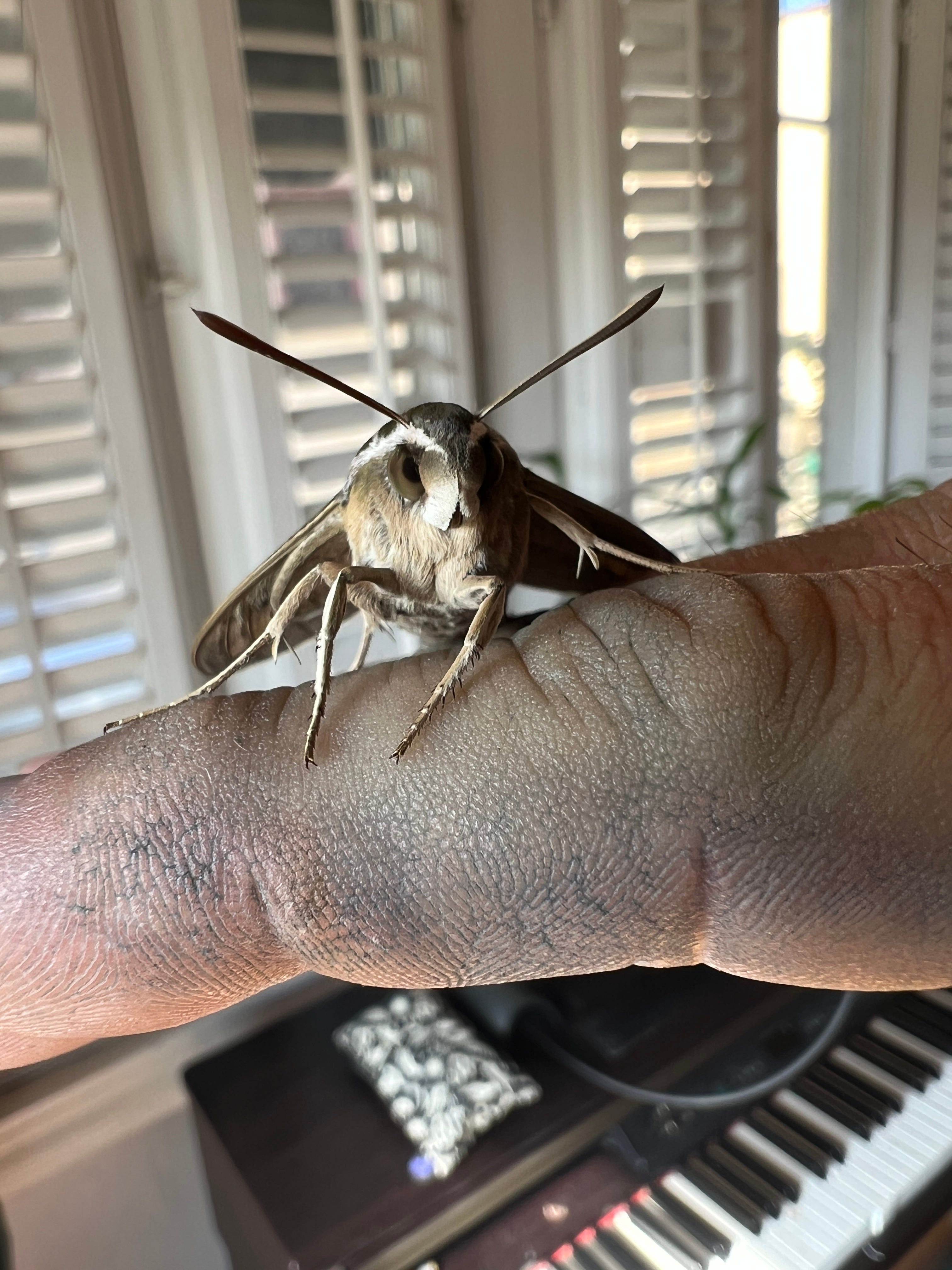
I later learned that these caterpillars were destined to transform into white-lined sphinx moths, nocturnal pollinators of the superbloom flowers and other desert plants, and that they, too, could survive a decade of drought in a kind of suspended animation under the desert floor waiting for the rains. These moths mate and lay eggs for the next generation of pupae who will wait until the next monsoon to emerge and gorge themselves on flowers.
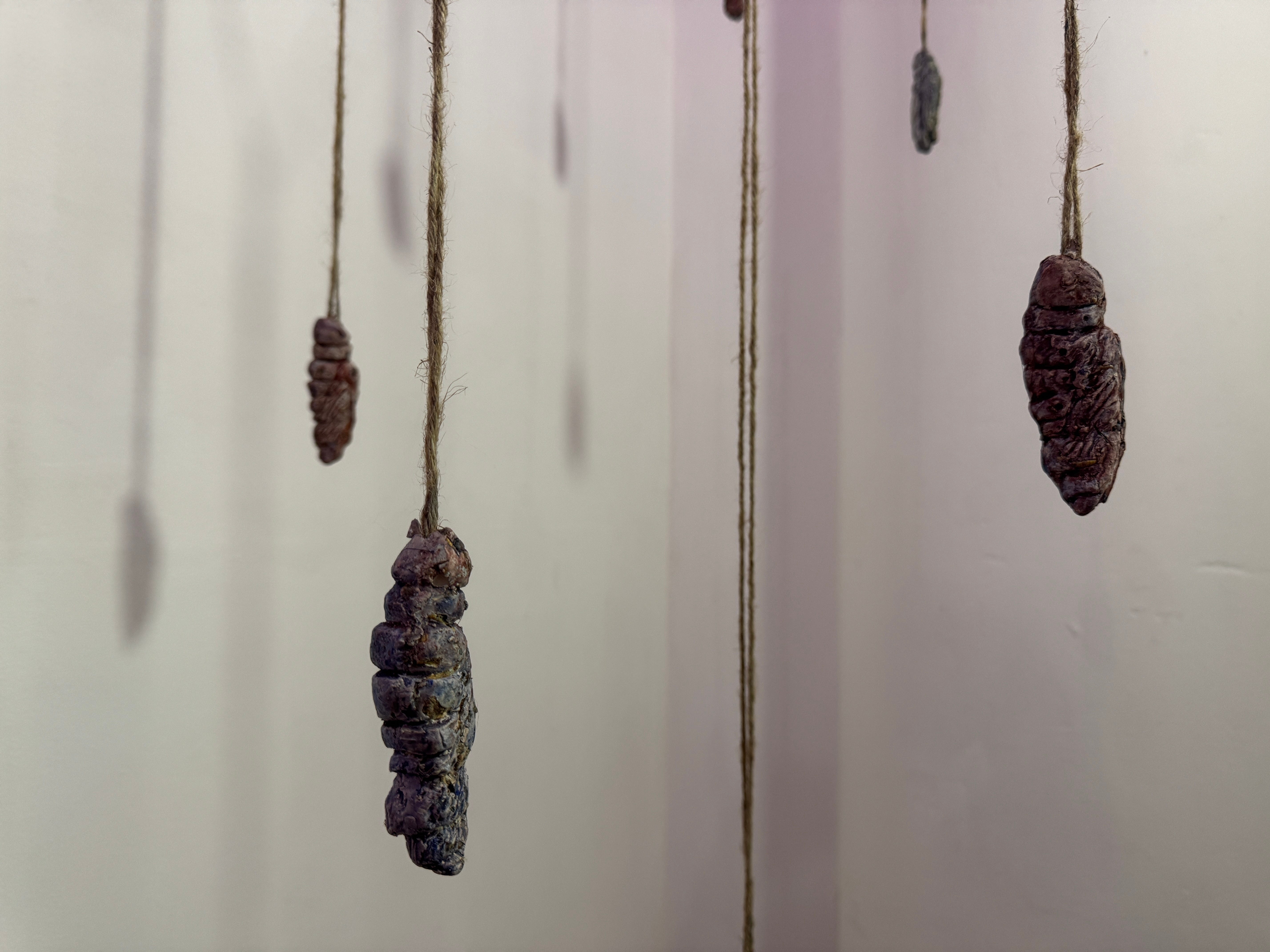
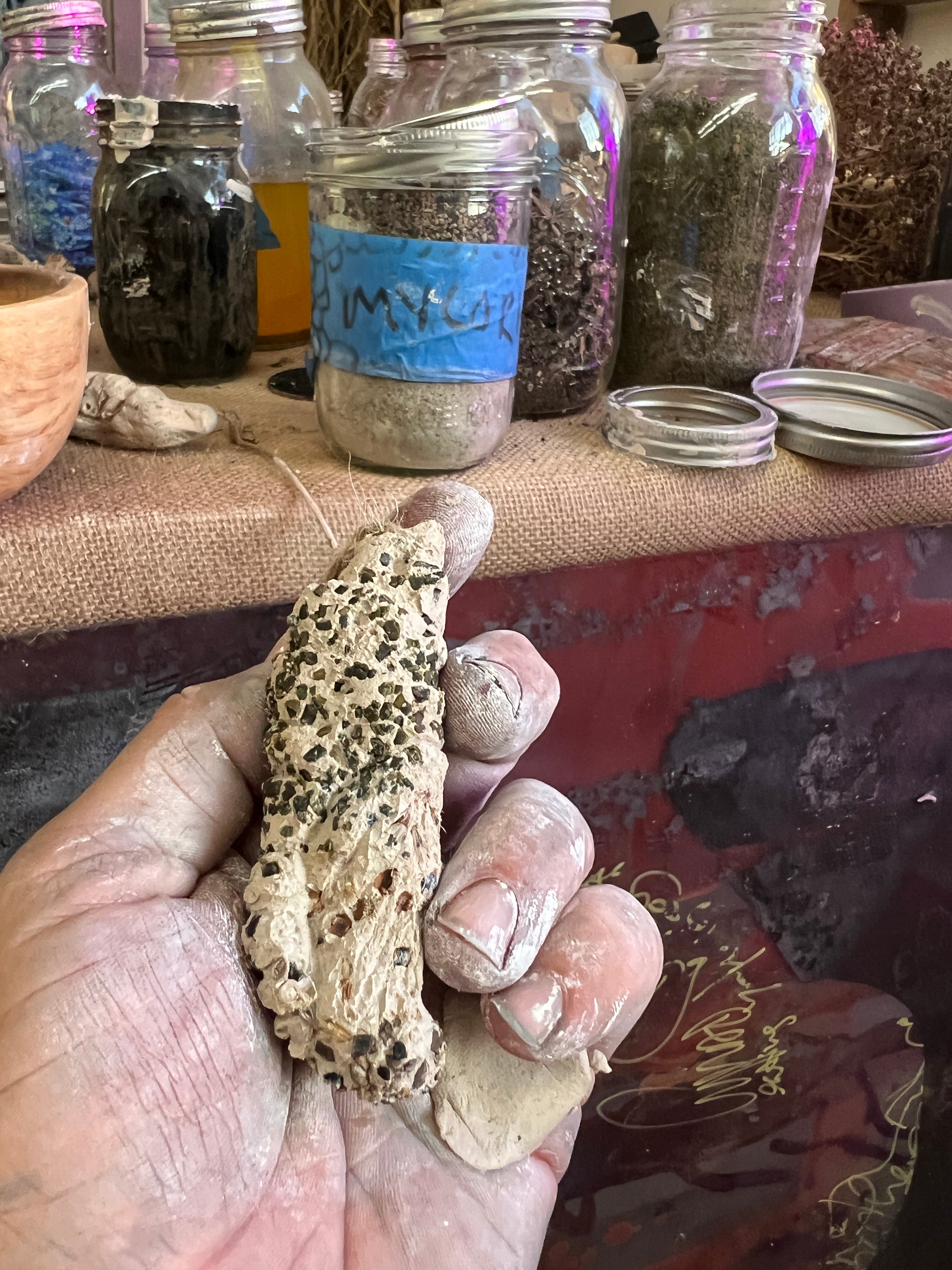
The pupae suspended in “Lord of the Butterflies” at Persons Unknown are live-sculpted from the pupal form of these caterpillars that I ordered from a breeder when I got back to LA. I lived with these pupae, took care of them in my house, and carried them around with me for several months in a bucket of dirt, introducing their twirling, twitching, incubating bodies to my students, sharing them with audiences at performances and exhibitions, and strapping them into the safety belt of the passenger’s seat beside me as I drove to and from the studio everyday. The pupae sculptures are cast with unfired clay, the seeds of superbloom flowers, dehydrated mealworms, and post-plastic mealworm frass (i.e., waste from my colony of polystyrene-metabolizing mealworms), and then coated in a nutritive film of egg tempera and iron-rich mineral oxides.
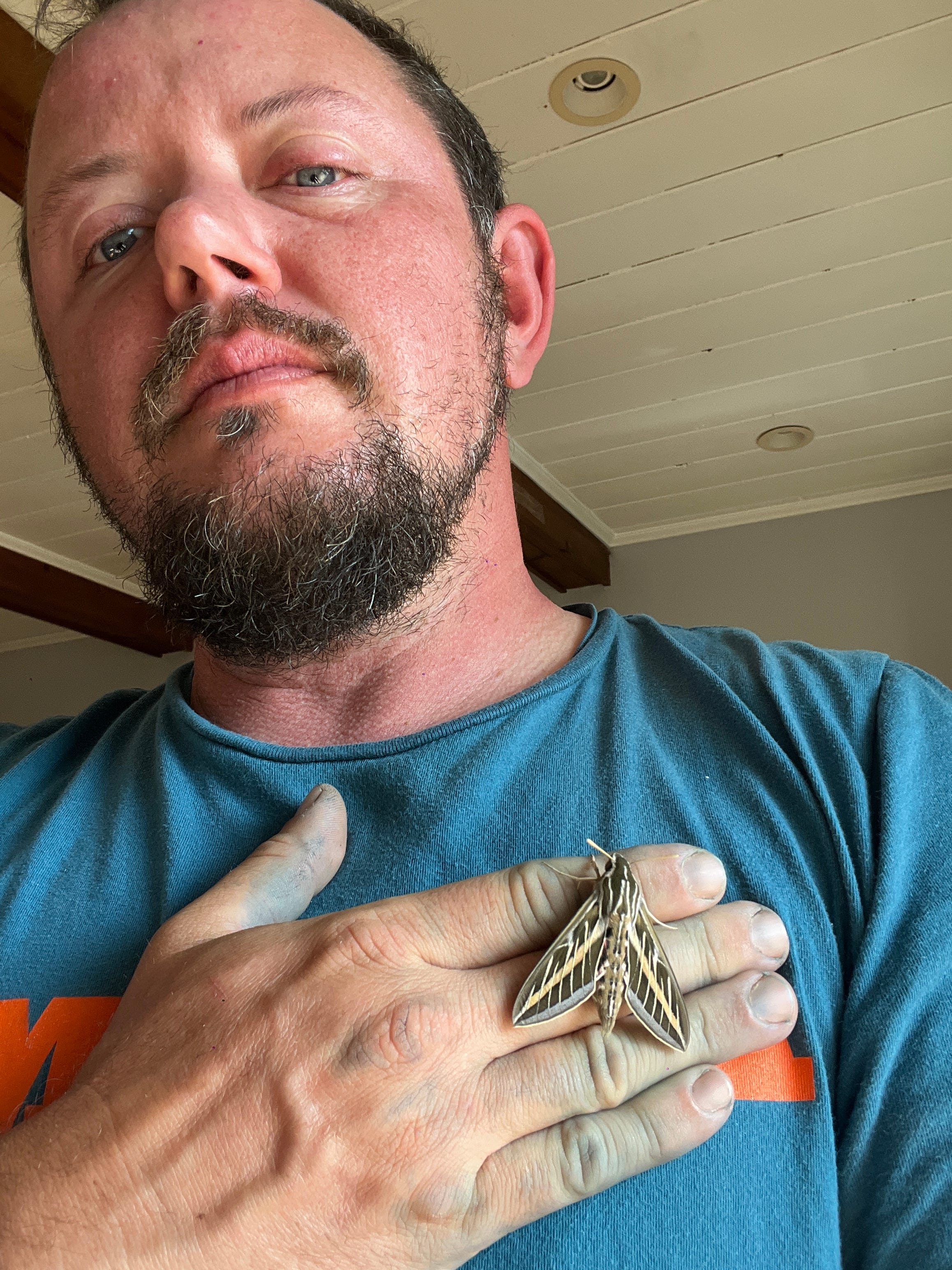
The loud buzzing hum and fluttering reverberating throughout the gallery come from audio recordings I made of the moths that emerged from these pupae. One of the pupae emerged from its chrysalis in my hand and lived with me loose inside my house for its full two weeks of life. I slept in the living room while it was alive, so that I could wake up in the middle of the night and catch it flying around and eating nectar from the flowers I foraged for it during the day.
This moth also died in my hand making eye contact with me as it laid four little green eggs. The body of this dead/alive moth is also a part of this show, laid to rest inside a ceramic bowl of water I suspended at the entrance to the main gallery like a basin of holy water. I filled this vessel with seawater from the lagoon near my house and several stems of superbloom flowers the moth ate during its life, and laid the moth to rest on a pink flower petal just above the surface of the water. A transducer on the base of the suspended bowl reverberated the water, flower, and moth with the sounds this moth made when it was alive.
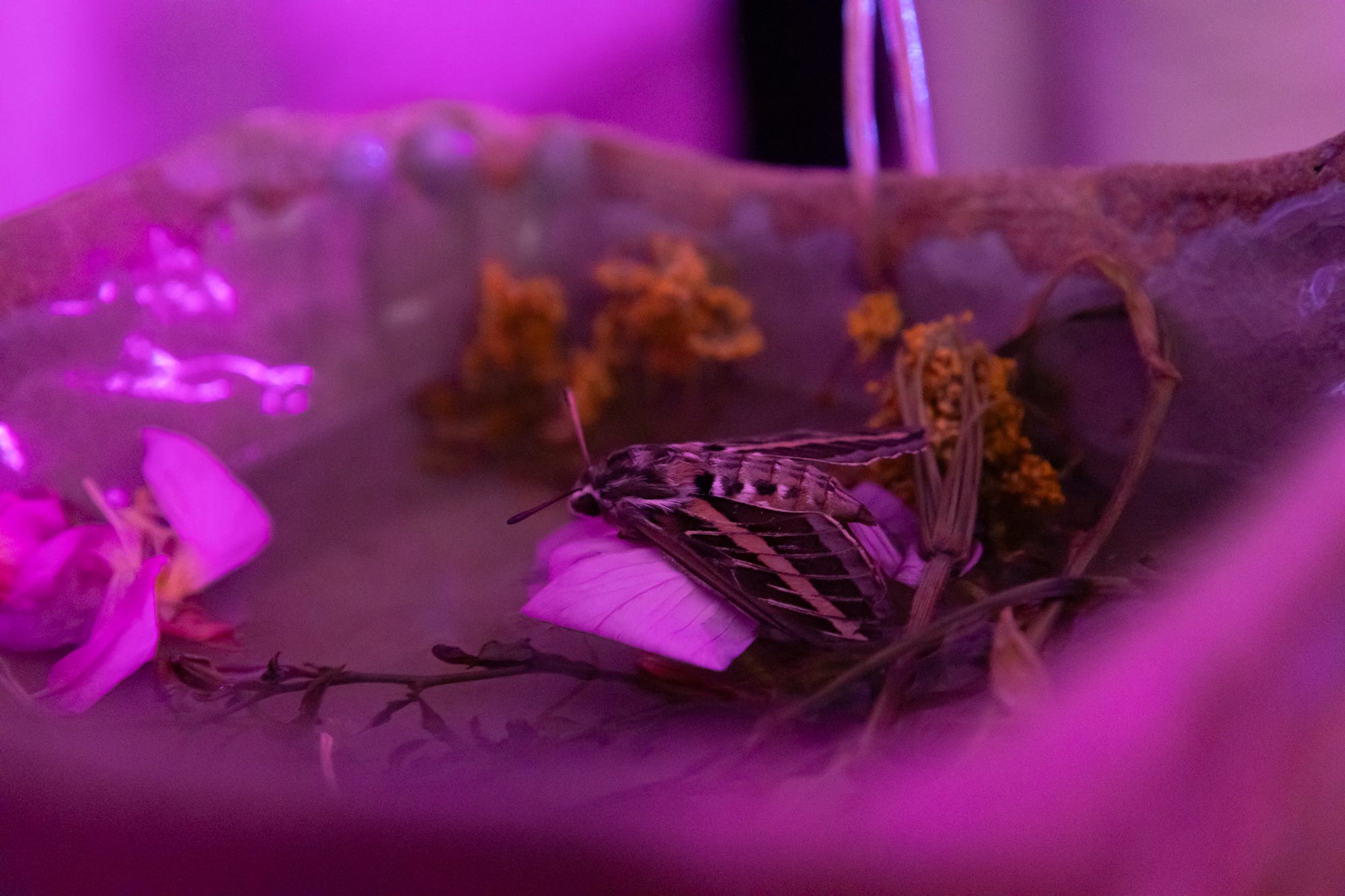
Like so much of my work, the dead/alive moth and flowers in vibrating water, the reverberating hum and fluttering coming from the walls, and the suspended earthen seed pupae transformed the space into a speculative temple of material transmutation, wonder, and grief, where time moves in multiple directions. The rest of the show flowed from that sense.
When I visited Persons Unknown with you, I accepted a frog sacrament—a jelly cube with a boba “egg” inside. What does it feel like to put art in someone’s mouth or to watch people eat your art?
Love this question. I’ve been researching proto-trans, non-binary, and intersex deities and their sex-shifting, queer plant and animal consorts for the last few years, building out a speculative, sometimes kinky, trans*ecological mystery cult as a new vein in my practice. The frog egg sacraments come from that research and cult-building. In January, I performed an hour-long speculative “liturgy” called Shapeshifter at 2220 Arts + Archives as part of Poetic Research Bureau’s Communicator Series, curated by Emji Saint Spero. That performance included a speculative liturgical text, weaving together facts about these ancient deities and their shapeshifting animal and plant consorts with related poetic Commandments, and live material alchemy/food prep. I included three “sacraments” in that performance: one to drink, one to eat, and one to “mark” the audience.
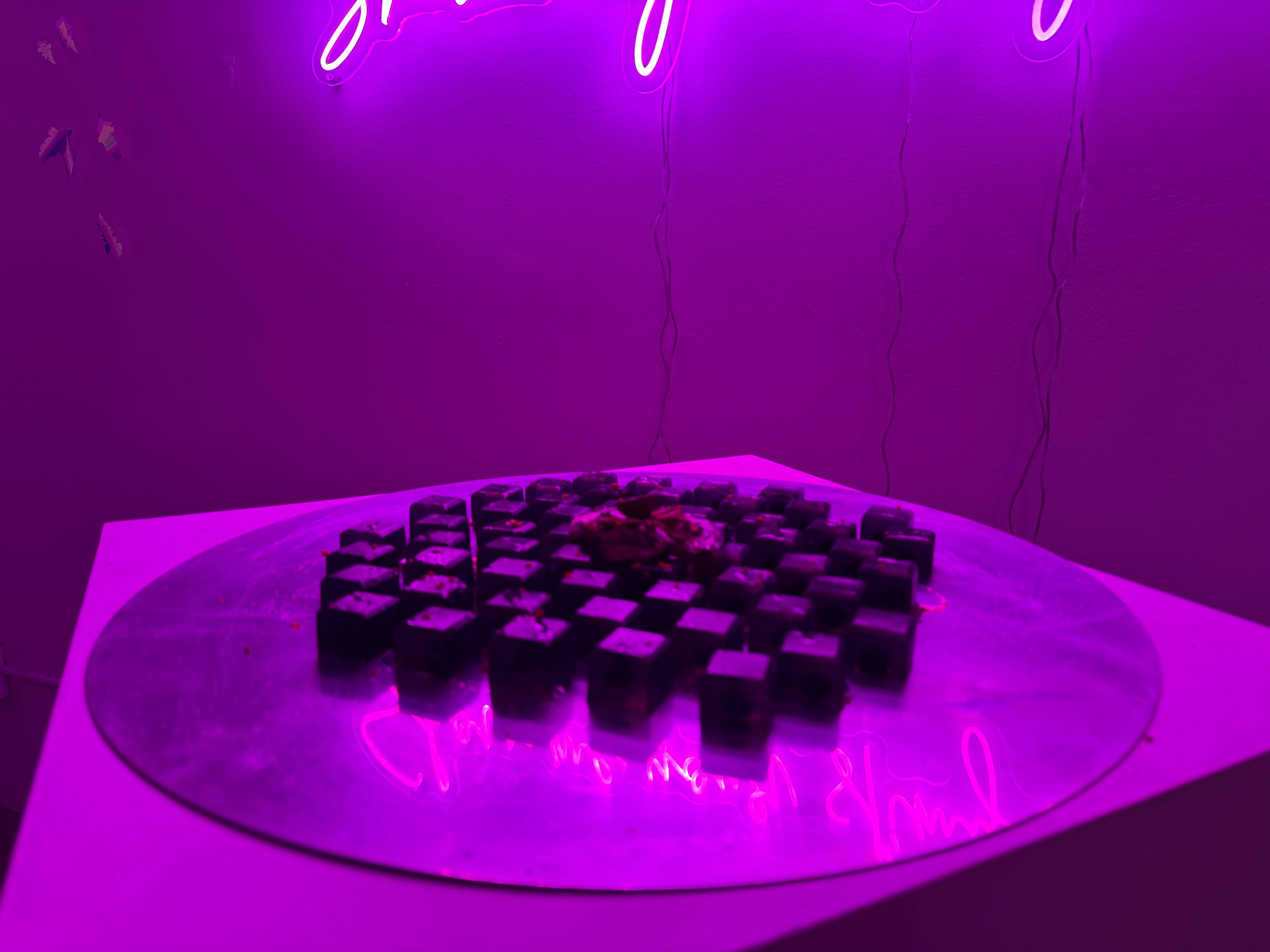
The frog sacrament comes from my research and writing on the Ancient Egyptian god Hapi, an intersex or proto-trans god of the Nile’s inundation who was depicted with the “false beard” of male gods, “round pendulous breasts,” and a “pregnant belly.” His animal consorts include the frog — a creature known to regularly change sex in the wild — and the blue Nile lotus — a flower that grows in anoxic mud and has been used since ancient times as an aphrodisiac and treatment for erectile dysfunction. Hapi’s frogs became extra compelling as subject matter to me when I compared how the Bible characterizes these slimy, sex-changing animals. They are sent as a plague in the Book of Exodus to punish the Egyptians for imprisoning the Israelites. In the Book of Revelations, frogs come out the mouths of three people, signaling the beginning of the End of Days.
When I read this passage, I thought, yes, that’s exactly what I want to see happen. I want to see all those suppressed frogs trapped inside all these people come out of their mouths and show me their slimy miracles. The frog sacrament you accepted and the neon sign commandment hanging above them (“Come out now the mouths of your captors. Show me your slimy miracles”) are materializations of that vision.
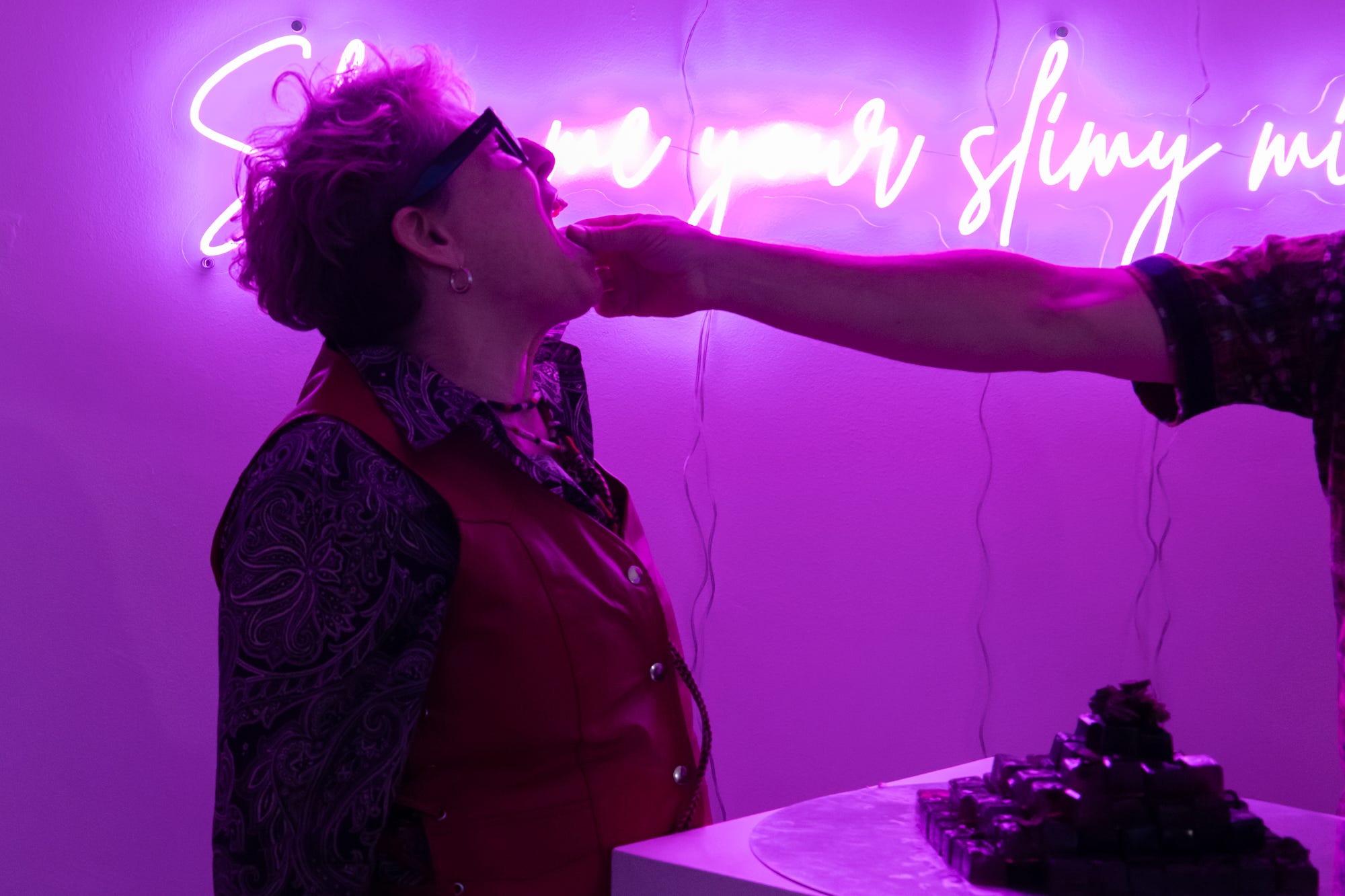
I like imagining that the act of putting these ambiguous colorful, nearly opaque, slightly sweet, gelatinous cubes of blue Nile lotus tea, bee pollen, and salty, slimy “real and true” frog eggs into the mouths of the public might be sufficiently disruptive, intimate, and strange to unlock some queer trickster energy buried inside them. Or at least tickle a suppressed curiosity about bodily uncertainty, impurification, and possibility.
It’s satisfying to watch people eat my art. You can tell it is a strange experience for most of them, a little awkward, a little scary, sometimes silly, sometimes intimate. Some are surprised by it or shy. A few were disgusted by unexpected flavors or textures. Several thought it tasted good. Some camped it up and performed queer maximalist delight. Many were fixated on trying to guess what exactly it was, which created room for layers of performativity and play.
I presented the object as the “real and true body of frog,” referencing the consecration and adoration script from Catholic practice. Several playfully penitent and pious participants responded: “body of frog.”
Tell me more about the religious overtones in your work, which extend far beyond the frog sacrament.
I grew up Catholic, but I also have Quaker and Unitarian ancestors. I think a lot about the magic and alchemical practices in Catholicism as a foil for my work. I grew up being told, for example, that a priest could turn bread into the real and true body of Christ by reciting a few simple words and gestures. And it did seem to me that the bread we were offered as Eucharist had fundamentally changed through the consecration. At the same time, I was being told that the materiality of my body could not be changed through any kind of ritual or material alchemy. It always seemed like more of a stretch to believe that bread could become God than that I could become a man. But maybe both are true.
I also think about the hypocrisy of anti-trans zealots fixated on the literalness of trans bodies, calling us delusional and saying we will never be whatever sex we say we are because a man is a man is a man and a woman is a woman is a woman. Or something like that. They talk about genitals as destiny and chromosomes as truth, and delight at transvestigating the details of strangers’ bodies to identify an endless string of physical signs that the person is “lying,” “faking,” or “deceiving” the public. Often the people targeted by these “transvestigations” are not even trans, like the wife of French president Emmanuel Macron, but that doesn’t seem to bother them — they are thirsty for trans blood and will drink whatever they find.
At the same time, many of these anti-trans crusaders insist that every person has a “soul” that is immaterial and separate from their physical body and that this “soul” is so real it has the capacity to live forever in a magical afterlife long after their material body has turned to dust. They say they believe in an immaterial plane of existence where humans can communicate with God, Jesus, saints, and the dead, maybe. And they say they believe in miracles — that God could cure them or their loved ones of cancer, for example, or make them rich through divine intervention.
But sex cannot exist in this immaterial plane detached from someone’s physical body, just their immaterial and immortal soul? And God cannot transform a trans person into anything other than the sex some arbitrary human assigned to them on a paper form at birth? This thinking is an insult to God.
Trans people have been considered sacred and magical since the beginning of time often because we show the potential of humans to move beyond our mundane and materially prescribed limits. When I reference quasi-Catholic and other religious practices and aesthetics in my work — a frog egg sacrament; fungal holy water; marking the penitent with post-plastic ash; altar/alter painting; egg tempera frescoes; metal-plated reliquaries; the triptych; an enormous clay lingam-like pillar performing a polyvocal track of sex-changing crocodile, frog, and dolphin recordings processed through human-voice filters — I want to appropriate these practices to point to the sacredness and real magic in the world: the magic of trans people; plastic-metabolizing mealworms; superbloom moths and wildflowers that can survive ten years underground with no food or water waiting for the rain; sex-changing frogs covered in hallucinatory goo who emerge with the floods; the blue Nile lotus flowers that can grow in thick anoxic mud, attracting metamorphosing beetles with their intoxicating scent and producing psychoactive properties to relieve anxiety and improve sex in humans; the majestic and fierce crocodile shifting sex with the water. I also hope that these usurpations of religious aesthetics open up space for people to imagine weirder, more emancipatory forms of divinity for themselves, while we antagonize the hypocritical and malicious gender fundamentalists.
Humans have been inventing gods and ritual practices for tens of thousands of years — long before Catholicism. Art is one of the places people seek out and maybe find or create divinity. I’m less interested in a cosmic god with a name and a face and a palace in the sky than I am in the collective earthly impulse/experience to find/feel/hear God in the living world around us and the practice of listening deeply to the earthly world around us to find/feel/hear the magic and majesty that is already there. I’m also more interested in the somatic and multisensory experience of a cobbled-together, broken, queer, buzzing, kinky sacredness than forming or leading an actual church with a parking lot, meeting minutes, and a fundraising agenda.
All of which makes me think about McKenzie Wark and Luce de Lire’s recent writing on temporary and surreal utopias as spaces that can’t be formalized, permanent, stable, or even really sensical. Maybe each artist’s practice is their own eccentric, idiosyncratic religion or flickering imperfect utopia.
Other foodstuffs also appear in this show and across your practice, including buttermilk, which you’ve used to create an opaque projection screen on the gallery’s windows, and mealworms, here embedded in chrysalis-like sculptures and alluded to in bottles of frass, aka mealworm poop, which is a by-product of your work with mealworms and Styrofoam. What is it about food or consumption that holds power in your practice?
Focusing on food, hunger, and consumption helps me reframe the nature of embodiment.
We are literally constructed out of the material we consume. Every cell in my or your body used to be something else. The fat in my brain cells coating my neurons so that I can actually think used to be fat in a mealworm or a fish or a peanut. The proteins in our genitals, the iron in our blood, even the material that makes up the strands of protein in our DNA used to be part of another different being. This material gets into the system that is my or your body through food. We think of our ancestors as individual humans, but our bodies are really materially descended from the water we drink and the food we eat, including all the hormone-shifting, carcinogenic pollutants contained in that water and food. None of that tissue is stable or fundamentally “yours.”
Eating and feeding are also deeply sensual, somatic experiences that can elicit fear/threat/trust, desire/hunger, pleasure/disgust, and literally collapse the distance between the viewer, the art, and the artist. We often think of desire and even pleasure as fundamentally human, sexual or maybe consumerist impulses — something we should probably distrust and likely repress for the good of earth and our physical, psychological, and financial health. But hunger, desire, and pleasure animate all living things, holding us together in complex ecosystems of material exchange and transmutation. This ecosystem of multispecies desire is embedded into every bite of food we consume, including in the blue Nile lotus tea, honey, and bee pollen I’ve brought together in these frog egg sacraments.
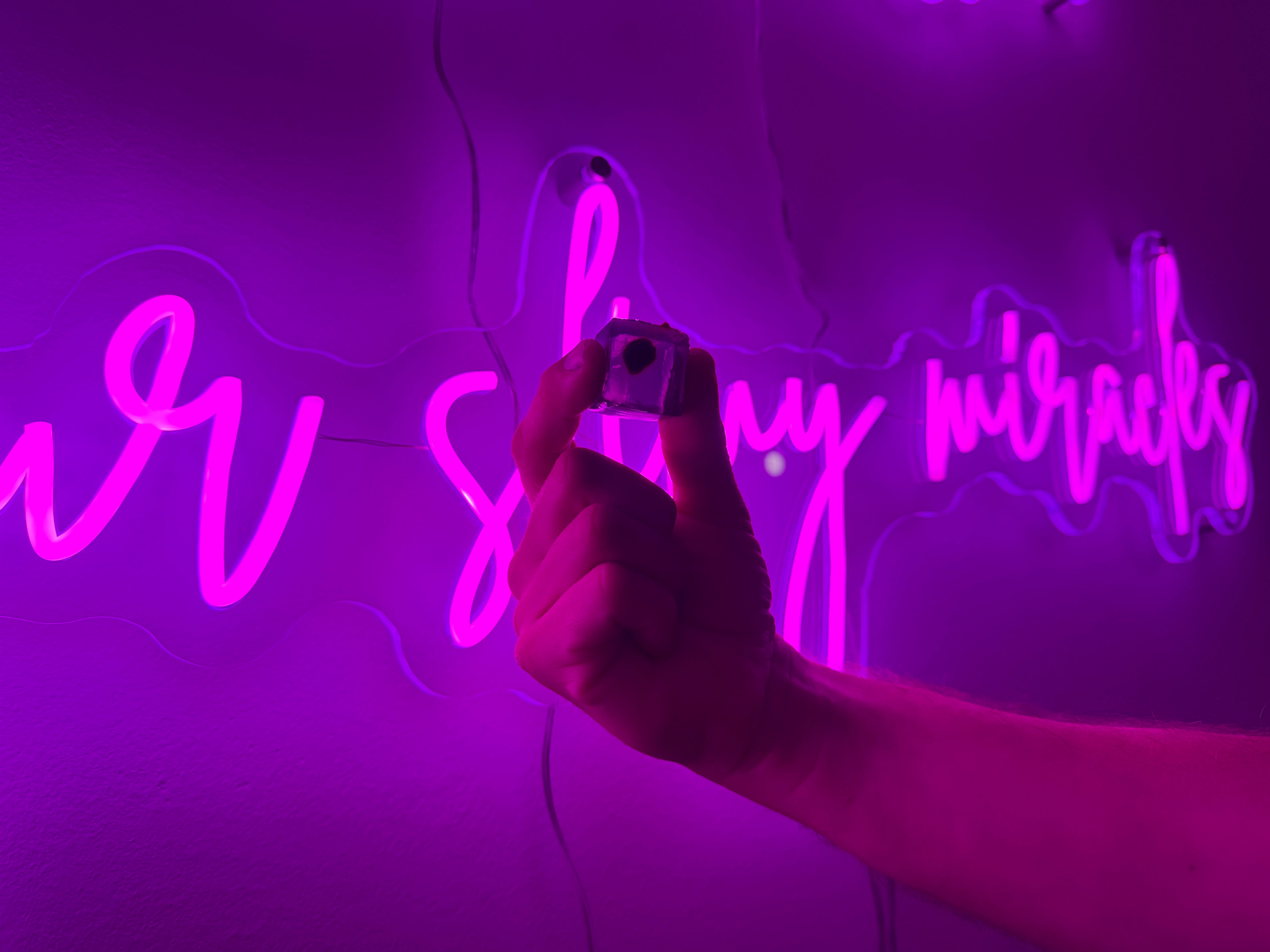
I’m also deeply interested in performative feeding as a strangely personal, somatically destabilizing, sometimes awkward encounter that can disrupt the tidy boundaries around “art” and “viewer.” So much of contemporary art engagement has been reduced into a cold, safe, distanced exercise of judging, categorizing, and dissecting “the work.” Many (most?) art viewing customs cater to this judgmental, dissecting, categorizing gaze, which I’ve referred to elsewhere as the cishuman gaze:
Let’s get those lights on really bright and make sure there is nothing in the way to obstruct the view. We will get out all the magnifying glasses, the microscopes, and the expensive projector, so you can see everything really clearly. And make sure there is enough room around the work, so we can look at it in isolation and get far enough away to take it all in from the outside. Turn around for me now. Give me a nice twirl. And don’t forget to smile.
This is a sad, somewhat nasty, version of what the art experience can be that echoes a lot of the competitiveness, jockeying, power games, and scarcity mindset of consumer capitalist culture.
People can try to distance themselves from my work and interrogate what everything “really” is, but I like working with food and feeding because it interrupts/disrupts this default mode of engagement. It’s much harder to stay in that disembodied, hyperverbal, analytical headspace when someone is shoving a slimy “frog” miracle into your mouth or dropping algae-nated “motor oil” on your tongue or offering to mark you with post-plastic ash and landslide mud crawling with roaches.
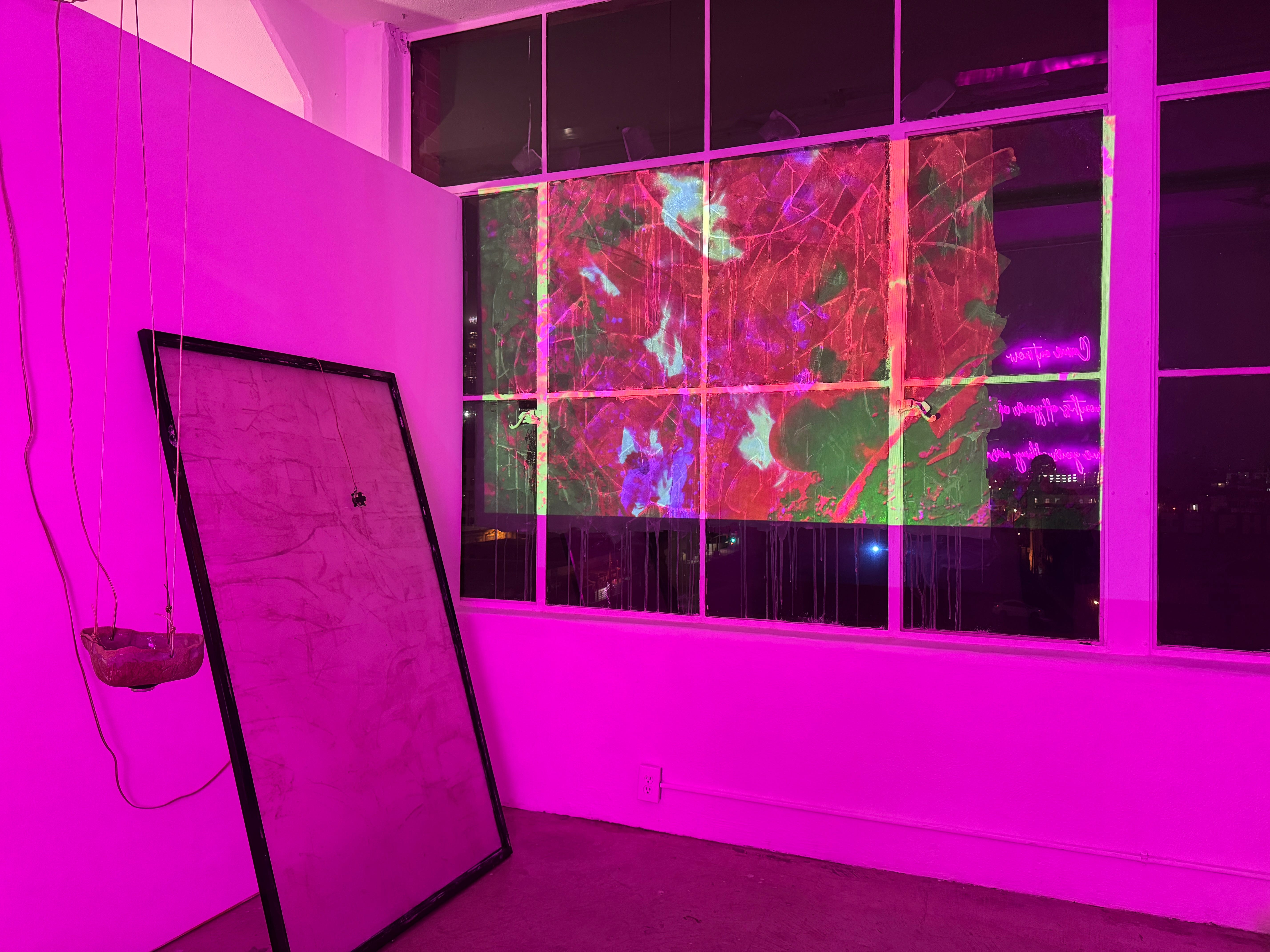
The buttermilk window is different because I’m not actually feeding the window surface to people, although licking the buttermilk window as a devotional gesture or performance of hunger/desire sounds pretty fun. It’s also a good example of how I invite materials to perform in my installations and my continuing amusement and delight when materials perform as something different from their assigned or expected state or purpose. Here, multiple viewers remarked to me that the veil of drippy smeared buttermilk looks more like a different kind of bodily fluid/slimy miracle. I didn’t set out to construct a giant cum veil as a projection surface, but I was amused when that read emerged. What could be better than a veil of milk that emerged from a pregnant cow performing as an illuminated shroud or curtain of semen? I’m interested in how viewers respond to the ambiguity of this bodily material. Do they feel “tricked” or angry when they discover that the “cum” is milk? Or the “frog egg” is boba? Or are they delighted and amused?
Many of the materials, processes, images, and metaphors in your work draw on and elaborate queer and trans theory. You gravitate towards all sorts of things that are non-binary, hermaphroditic, or transmutational—things that really explode binary, hetero, cis, and anthropocentric modes of thinking and worldbuilding (or world-destroying...). Can you talk about the theoretical or philosophical aspects of your work, and how they relate to your deep interests in materials?
Material really is trans. Always shifting, never stable. Always becoming something else. Through a mealworm’s digestive system, for example, even the bonds that hold a molecule of polystyrene plastic together can be broken, and the energy and carbon that were once trapped inside that plastic molecule can be set free to fuel the mealworm’s metamorphosis. Through the mealworm’s embodied alchemy, the polystyrene becomes beetle, shed, and nitrogen- and phosphorus-rich frass waste that can be used as a nutritive fertilizer in any garden.
Trans — as a medical prefix for transgender — was derived from organic chemistry, where “trans” means to switch sides and “cis” means to stay on the same side. All of us have cis and trans molecules in our bodies — in this sense. Human vision actually requires a rapid shifting of cis-molecules into trans-molecules.1
Humans tend to focus our attention on bodies and objects with faces and names that we can turn into characters for the narratives we construct to make meaning out of the world. But all these bodies, names, objects, and characters are fleeting assemblages of flowing, shifting, coursing — i.e., trans — material. This sounds very abstract or even esoteric, but people are fighting wars and stoking genocide over their fixation on the sacrosanct and inviolable truth of these constructed categories.
Your question is about queer and trans theory, but I’m thinking a lot more about genocide right now. I read a book in college called Moral Purity and Persecution in History in a class on “liberalism and its discontents” taught by a psychiatrist-turned-political-philosopher. I think about that book often these days. The book details the ways that concepts of “purity” and “filth” have been used throughout history to justify war and genocide. Mary Douglas’s Purity and Danger presents an ethnography of similar practices and taboos across a different set of cultures through an anthropologist’s lens.
Transness and queerness are just some of the human practices and subjectivities that have been and are being criminalized and vilified as impure, dirty, filthy, and dangerous, and subjected to campaigns of persecution, erasure, and eradication. I work with dirt, insects, and taboo animal products like insect waste, rotting egg yolks (in the egg tempera on the suspended pupae), and rotting milk (buttermilk on the projected film screen) to push against and activate these notions of purity. I like the spectacle/theatrical strangeness of that as a performance in itself. So often we go into art spaces expecting to be coddled and attended to, with a concierge on hand to explain everything to us, so that all the ambiguity, tension, mystery, challenge, and potential discomfort of the work is resolved for us and we can move on to the next show. I hate that smug tell-me-what-it-means-already-so-I-can-consume-this-work-judge-it-and-you-and-move-on-to-the-next-spectacle vibe.
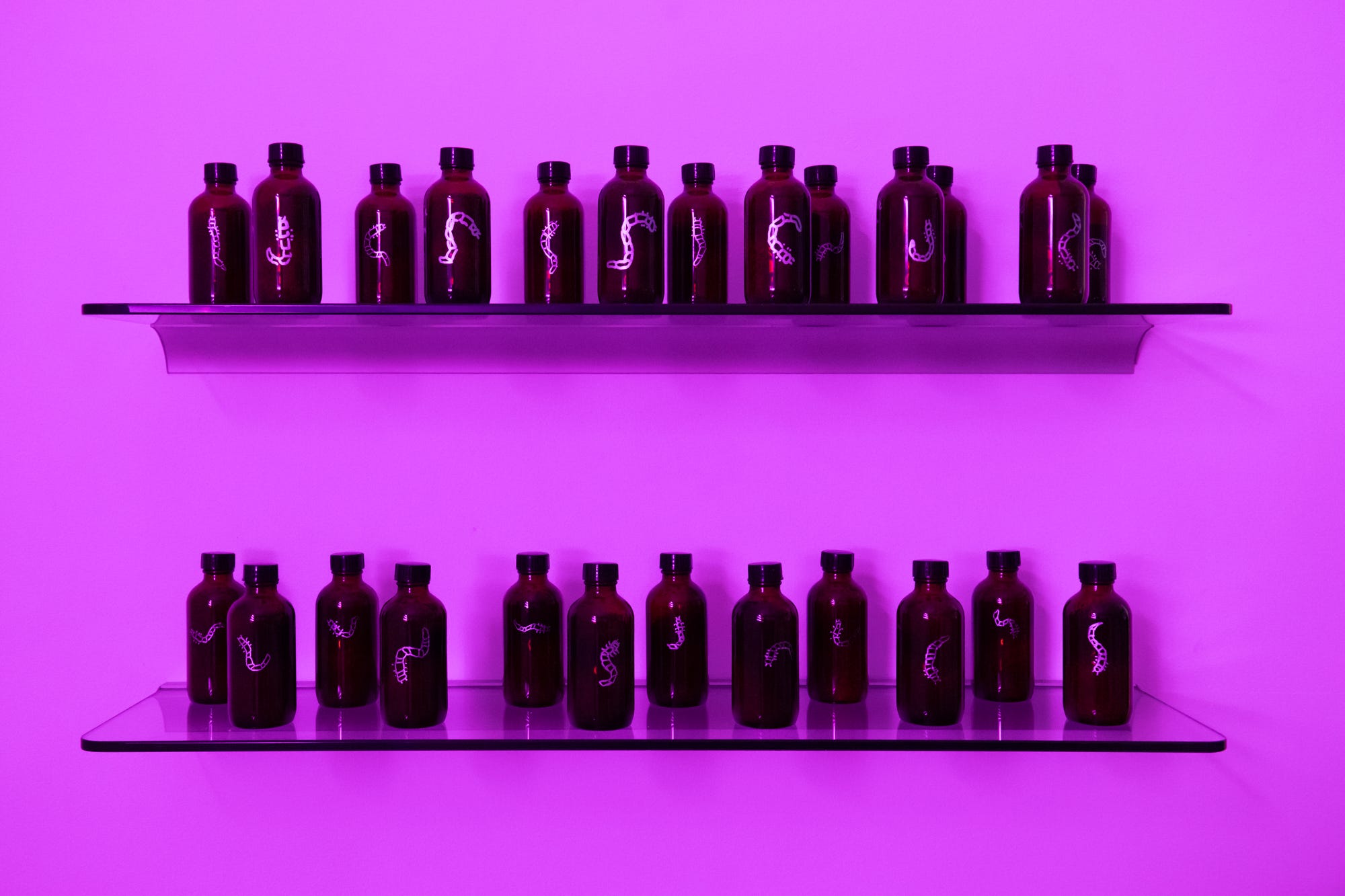
But it’s also important that the other shoe eventually drops for at least some viewers. All the things I’m putting into these spaces to disquiet, unsettle, unnerve, threaten, and disgust are working some kind of trans and queer magic. The mealworms are metamorphosing themselves and the polystyrene they consume. Their post-plastic waste, presented here as medicine in a row of glass medicine jars on glass shelves, is grotesque, maybe, but the phosphorus, nitrogen, and carbon in it is also capable of nourishing plants, fungi, and animals in the soil, and eventually recombining into food that you may eat and, eventually, you.
The moth you are hearing and seeing in the show is from the species that can survive underground in pupa form for a decade with no food or water, just waiting for the rain so that it can emerge and surface at exactly the same time as its food source.
The frog egg sacrament is a performative ritual that is meant to be a little absurd and blasphemous, but it also contains the actual tea of the blue Nile lotus flower — a medicinal plant used since ancient times as an aphrodisiac and to treat a variety of ailments, including erectile dysfunction.
The buttermilk is performing a kind of trans material fertility joke of milk-cum-cum but it’s also demonstrating its miraculous capacity to both hold and transmit projected light, transforming the things we look through (window/glass) (and typically ignore: the invisible “lens”) into a thing we look at, transforming the lens/window into a performing/writing/speaking surface.
The result is not so much a linear argument or rhetorical exposition, but an assemblage of research-based facts, material demonstrations and performances, sensory phenomena, and mischievous queer attitude that I offer the viewer to experience and grapple with. I want this assemblage to challenge or unsettle their expectations of what is beautiful, precious, disgusting, safe, sacred (even), but I also want them to think and feel through the unsettled pieces for themselves. There is no one correct or easy answer I expect them to build with them.
I find permission and solidarity for this nonlinear, sometimes absurd, multisensory and maximalist, deconstructed and deconstructing, affect-forward approach to artmaking in many queer and trans theorists’ work, including Timothy Morton’s writing critiquing judgmental, linear, and straight environmentalist discourse as compounding the ideological paradigms that have brought us to the edge of collapse (see, e.g., All Art is Ecological; and “Queer Ecology”); Luce de Lire’s critique of critique as a spectacle that distracts us from action; and Jack Halberstam’s writing on unworlding, the aesthetics of collapse, and the Queer Art of Failure as necessary and generative processes in themselves.
You have a fascinating background that shows up in your work in subtle but revealing ways. Your undergraduate degree is in anthropology and you went to law school and practiced for some time. How do those experiences inform your artistic practice?
In a lot of ways, I think I’m practicing now the thing I set out to do when I decided to go to law school. I went to law school in my early 20s to push back against the bullies who came for me as a visible queer/trans kid growing up in West Virginia in the 90s, and to try to make the world a more livable place for other kids like me and people like my mom, who died of pollution-linked cancer when I was 26 after being treated like waste by the local plastic factories who forced all of us to breath carcinogenic air for decades just to bolster their profits. I’ve just moved on from the notion that logic, argument, reason, sincerity, or appeals to abstract concepts like fairness or justice will persuade anyone with power to change anything at all.
I studied and practiced law for almost ten years before turning my attention to art as the primary vehicle for my research, thinking, and public engagement. I worked as a civil prosecutor for the US government, enforcing federal health, safety, worker protection, and anti-fraud laws. I deposed coal mine operators about the conditions that led to mine explosions, corrupt fiduciaries about their elaborate schemes to misappropriate employee investment funds, and Amish roof builders about religious freedom. I argued a novel common law theory before the Fourth Circuit Court of Appeals before I turned 30; rose for the Honorable Judge Funk in a bankruptcy court in Jacksonville, FL; and questioned a witness on the stand in Reading, PA, during an earthquake. My relationship to material, language, research and performance are deeply influenced by these formative experiences.
Every gallery feels a little like a courtroom or the scene of a crime and every object feels like evidence or a prop for a performance of ceremony and power. Viewers feel like witnesses who might be called on later to testify, clients who need me to show them what’s really going on (good or bad) so that they can make informed decisions about what to do, and/or judge and jury with the power to evaluate my case, render verdicts, and take away or give back life. I sometimes reference the formal aesthetics of legal practice in my work to make these resonances more available to my audience — e.g. in the statement of facts artist book I created for my 2024 solo show “Worm Hole: A Portal for Plastic Bodies.”
I also studied anthropology in undergrad, which influences how I think about the land, material culture, and social customs. I relate to the land as a living, feral archive, and to objects and bodies as material culture that carry information in their physicality well beyond the intentions of their makers, including evidence of more-than-human agencies like fungi, bacteria, water, and mineral/geological forces.
Like a good anthropologist, I think of object- and image-making as cultural practices that are always relational, always ecological, and always collaborative, even if we put the name of a single artist on the gallery window. My objects are not isolated art pieces that I understand as individual sculptures or paintings, but performative interventions that transform the environments around them into something else — and/or as physical scores that invite relational and somatic engagement. The suspended pupae in “Lord of the Butterflies,” e.g., work in both ways: (1) as objects that transform the space of the gallery into a subterranean field of pupation and waiting; and (2) an invitation to the viewer/owner to take this object, wear it, and/or bury it in the ground.
I also think about funerary practices, fertility rites, public space, the monument, and ornament across an anthropologist’s breadth of time and culture. I’m just as likely to think about Göbekli Tepe, with its twelve-foot-tall carved stone animal/human towers; the Crocodile Temples on the Upper Nile filled with mummified Nile crocodiles; the winged phallus mounted on the terracotta red plaster walls of Pompeii; the Rosetta Stone; Hammurabi’s Code; and the mummified beetle/canopic jars as references for my work, as I am to think about Marcel Duchamp or Ana Mendieta or Tracey Emin. My approach to material ecosystems also shares an anthropologist’s perspective; Donna Haraway trained as an anthropologist as did Anna Lowenhaupt Tsing, author of The Mushroom at the End of the World.
Your work often reflects on the state of the planet—this beautiful place with natural environments that are alive and still full of magic and mysteries, despite having been wrecked in fundamental ways by capitalism and every other appearance of human arrogance in the world. Somehow, though, I find your work playful and optimistic. Is your work a solution? A personal or collective coping mechanism? Poetry or politics or both?
Yes, thank you for seeing and feeling this complexity. My work is an act of playful, hopeful, and defiant disobedience that I hope will inspire and make space for other kinds of disobedience. It is a refusal I have been living and nurturing since I was four years old and first told my parents I was a boy: a refusal of normalcy, comportment, acceptability, the obligation to perform “nice” behavior and create “nice” things, to reduce myself or my work to a straightforward story for easy digestibility, or to ignore the magic and changeability of the world/our bodies/language. In a world where doom, dread, and shame are omnipresent and the apathy, despair, and isolation they breed are politically useful to existing power structures, the hopeful playfulness you sense is the disobedience.
I don’t think of my work as a solution to a particular applied problem — e.g., plastic pollution — although it sometimes passes as solution-oriented. It is an effort to find a way of surviving these times without losing the parts I love most about myself and others, including the possibility of imagining a better, more livable world. That sounds a bit like a coping mechanism, but the impacts of my practice matter to me, too. And I want to be more than a salve for myself or others.
The work is an effort to find and share a way to “stay with the trouble” of living and dying in this age of capitalism-fueled mass extinction, not an offering of easy solutions or an assurance that everything will be ok, but a reminder or proof that there is so much magic, beauty, intimacy, surprise, wonder, curiosity, and defiant vitality/mutation/adaptation, absurdity, play, humor, and pleasure to be found within and among the world, especially if we are brave enough to look at all the death and suffering coursing around and within us. Like transness, a lot of this magic happens at the edges of life and death, pleasure and pain.
So the work is more of an ongoing opera/symphony/poetry for the end of the world than a strategic political campaign. But I know every work of art is political to the extent it either reinforces the status quo and existing distributions of power or challenges them, and I embrace the deeply political significance of my work, especially now in this time of raging, global anti-trans animus.
My understanding of my work is also informed by my time as a practicing attorney. This work is not a linear argument or case for a particular outcome, a moralistic lecture designed to shame you into action, or doom porn designed to titillate your nihilism or collectively absolve us of responsibility for any action because everything is going to hell anyway.
It is more like a contagion or a vector for a subjectivity, attitude, wisdom, and knowledge that can be transmitted through shared air, touch, food, and feeling, like a virus. Like, you are going to come into this show and I will try to infect you or inoculate you with a virus/vaccine that will help you mutate or adapt into a different kind of creature. If it works, you’ll leave as a carrier for something you didn’t have before. Months or years later, it might explode from you like spores from fruiting fungi or come out of your mouth as a fully formed frog you didn’t quite realize you were carrying.
What’s your wildest ambition for a work you haven’t yet realized?
I’m dreaming about a speculative refugee camp turned laboratory turned temple where survivors of the Authority’s Normal, Real, and Right eradication campaigns can gather to rest, recover, and begin to develop our own actualizing technologies, archives, and myths. I want to build a working farm laboratory where AfterWorld initiates can reverse-engineer our stolen gender-affirming technologies with live plants, crowd-sourced data, and hacked lab equipment. I’d build a giant lightbox with a suspended mirror above it — part altar, part lectern, part room-sized overhead projector, part stage — within a living library of crowd-sourced science, notes, drawings, poetry, and images, so that anyone can explore the poetics, aesthetics, and science of these technologies as found collages of moving images projected onto the walls and ceiling of the space activated by the public.
There would also be an interspecies oral history and mythmaking station where new initiates could offer their actualizing stories and listen to other survivors’ stories projected from the walls and ceiling of the bunker like a worldmaking/worldbreaking rain. I’m deeply fascinated by animal voices and language, especially the voices of creatures who change sex or embody multiple sexes at once. So this architecturally installed sonic rain would also include channels of voice from crocodiles, frogs, dolphins, sea turtles, and particular species of sex-changing and intersex birds and fish.
The bunker would also include a shrine of speculative posthuman, trans-mythic deities, grown over the life of the exhibition, with materials we develop on site: e.g., yam- and soy-based bioplastics, endocrine-disrupting plastics, and mycelium-reinforced earth seeded with pollution-consuming and hormone-(dis)regulating seeds.
Visitors to the AfterWorld would be treated as refugees and mystery cult initiates who will need to accept three inoculating, impurification sacraments before they are fully admitted into this mysteries: one to impurify the blood, one to impurify the mind, and one to impurify the flesh.
I can also see a chamber of translucent icons derived from histology slides of these sex-changing and nonbinary creatures’ shifting sexual organs that would hang from the ceiling like banners, windows, or mirrors. I’m actually visiting several massive collections of zoological tissue samples in London this month to gather some of the raw material for these composite images.
Ideally, the AfterWorld would be up for a while with several thoughtful ways for viewers to participate in its growth and evolution. I just saw Yoko Ono’s show at the Broad and was really inspired by the variety of playful ways that the “viewer” is invited into her work. There should be regular activations and performances within this AfterWorld, including sessions where I teach people how to care for, propagate, and derive testosterone from yams (apparently there is a mycobacteria that will do this for you); and dinner parties where we cook with the scraps of these plants; Sacrament Tuesdays (or something cheeky like that) when I bring in fresh frog egg sacraments to impurify everyone; and research-informed performances for and by the pollution-metabolizing fungi growing in the shrine, structured using frequencies that have been found to help these fungi grow.
If money and time are no object, I’d also build a living tilapia aquaponic system to nourish the plants and then feed the tilapia to everyone at the end of the show. Among other fascinating things, tilapia come from Hapi’s Nile. When raising Tilapia, it is common practice to add androgens to the water so that all the fish become male. Apparently, male tilapia grow much bigger and much faster than female tilapia, so farmers do this to increase their margins. Tilapia are also regularly fed with mealworms, so it would be super easy to bring this whole ecosystem into material communion with the larger post-plastic one I’ve been growing for the last five years.
So, yeah, just that.
To learn more about Ashton’s work, visit his website and follow him on Instagram.
Editor’s note: I was totally fascinated by this and asked Claude (sorry not sorry) to explain it further. “Here’s the mechanism,” Claude explained. “Photoreceptor cells (rods and cones) contain a visual pigment called rhodopsin (in rods), made of a protein (opsin) bound to a light-sensitive molecule called retinal. In darkness, retinal sits in a bent shape called 11-cis-retinal. When a photon hits it, retinal absorbs the light energy and isomerizes — snaps into a straight, trans configuration (all-trans-retinal). That single cis-to-trans shape change forces the opsin protein to change shape too, which triggers a signaling cascade that ultimately produces the nerve impulse sent to the brain.” 🤯